Marvel Rivals map-locked hero challenge: how Salty Phish turns every queue into a new team comp
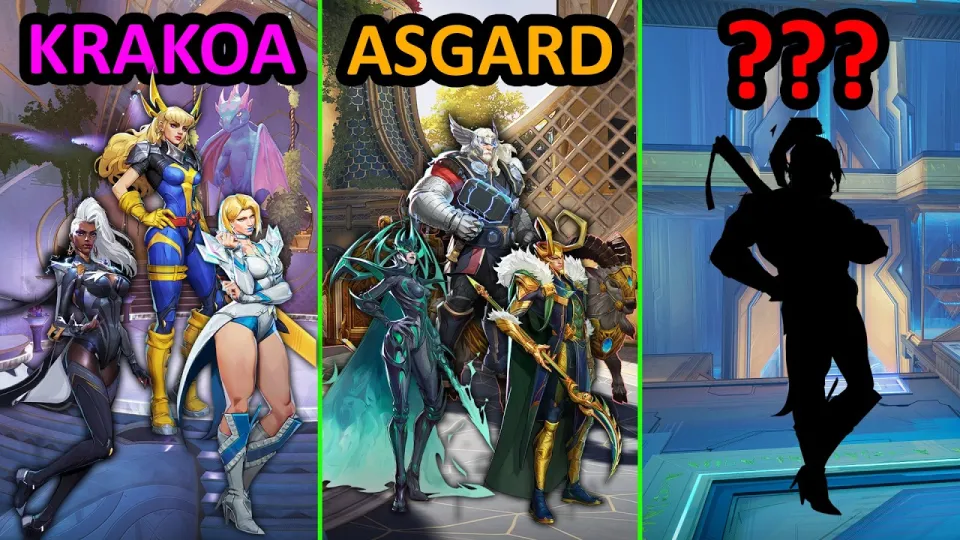
Video: The MAP Decides Our Heroes in Marvel Rivals
Want articles like this for your own video to promote it on YouTube and Google? Order them through the Telegram bot @sat_sit_bot. It writes articles around your video, embeds the video and publishes them on popular niche websites (no ads). Free trial — 50 articles.
· based on the channel Salty Phish
Key takeaways
- The rule set: each Marvel Rivals match is played with a hero pool determined by the map you queue into, not by player preference.
- Klyntar maps lock the team to symbiote-linked heroes such as Venom; Asgard maps open Thor, Loki and Hela.
- Shin-Shibuya is a 2099 setting, which fans argue should also unlock Punisher and Captain America.
- Wakanda's spaceport canonically connects to the Guardians of the Galaxy, who depart from there toward Klyntar in Rivals lore.
- Devil Dinosaur lives in New York with Moon Girl, so Lower Manhattan maps arguably unlock him.
Marvel Rivals is a hero shooter where the map you load into usually changes your strategy, not your roster. The map-locked hero challenge flips that: before the match starts, the map itself picks which heroes you are allowed to play, so Klyntar means symbiotes, Asgard means Thor, Loki or Hela, and any deviation from that pool counts as a broken rule. Salty Phish built a full casual series around this idea, streaming the runs live on Twitch, and the format works because Marvel Rivals has enough location-specific lore to justify almost any restriction you invent.
The appeal is simple: instead of one comfort pick every game, you get a rotating puzzle. A team that queues into a Wakandan map has to justify every pick against the fiction of that location, and the audience gets to argue about whether the justification holds up.
How the Marvel Rivals map-locked hero rule works
The core mechanic is a one-to-one binding between the queued map and the legal hero pool, decided before anyone leaves the spawn room. There is no drafting, no counter-picking and no switching to a comfort main when the comp starts losing; the map is the draft.
- Queue into a match and identify the map immediately, before hero select commits.
- Apply the map's lore pool — for example, symbiote characters on Klyntar, Asgardians on Asgard, Wakandan and space-faring picks on the Intergalactic Empire of Wakanda maps.
- Lock a hero from that pool only. If the pool is small, the whole team plays the same narrow comp.
- Treat any off-pool pick as a lost point, which is what keeps the challenge honest across a long session.
- Rotate to the next map and rebuild the comp from scratch.
The result is a self-imposed ruleset that tests game knowledge as much as aim. Knowing that a map is set in 2099 or that a building on it belongs to a Stark subsidiary becomes a competitive advantage.
Which heroes fit each Marvel Rivals map
Map-to-hero mapping is the heart of the challenge, and the obvious answers are only the starting point. Klyntar hands the roster to Venom and anything symbiote-adjacent. Asgard maps open the Asgardian trio of Thor, Loki and Hela. Wakanda maps pull in Black Panther, and because the Rivals version of Wakanda is an intergalactic empire with a working spaceport, the space-faring roster becomes fair game too.
Shin-Shibuya is the trickiest of the set: it is a 2099 future Tokyo, so the natural picks are the future-flavoured heroes, while Midtown and Lower Manhattan lean on New York residents and street-level characters. The tighter the pool, the harder the match — a single-map pool of two or three heroes is where the challenge actually bites.
The lore arguments fans keep raising
Fans of the format immediately started auditing the picks, and their objections are usually grounded in Rivals' own backstory rather than the films. Iron Man, for instance, has a legitimate claim on Shin-Shibuya because the Stark-Fujikawa building stands on that map and he even has dialogue referencing it. Jeff, Psylocke and Mantis were imprisoned in the Collector's museum in the game's lore, which stretches the museum map's pool well beyond the obvious picks.
Spider-Island 2099 draws the same complaint from the other direction: Punisher and Captain America both have 2099 counterparts, so restricting that map to a narrower set looks inconsistent. The Wakanda spaceport has an even stronger case — the Guardians of the Galaxy were hired by Black Panther in Rivals lore to deal with the symbiotes on Klyntar, and the Milano can be seen departing the port in map animations. Bucky Barnes is another recurring argument, since the Wakandans built his arm in Rivals canon, not just in the MCU. And Devil Dinosaur, who lives in New York with Moon Girl, is a New York character by any reasonable reading.
Why the format suits Marvel Rivals quickplay
Quickplay is the right home for a ruleset this restrictive because nothing is on the line except the experiment. A narrow, lore-locked comp will sometimes be objectively worse than the meta answer, and that is the point: the fun comes from making a bad hand work rather than from climbing.
It also keeps a long session fresh. Instead of the same three heroes across an evening, every map resets the conversation — who is legal here, why, and which pick is the least indefensible stretch. The best moments in the format are the arguments, not the scoreboard.
Common questions about map-based hero picks
Players trying the challenge themselves tend to hit the same three problems: pools that are too small to field a functional team, maps with no clear lore anchor, and the temptation to bend the rules mid-match.
The practical fix is to allow a "stretch" tier — characters with a documented connection to the location, like a Stark building or a canonical prison stint — while keeping the core pool strict. Maps with genuinely no anchor, such as generic urban layouts, can be assigned a thematic pool instead: an elemental team, an animal-kingdom team, or a faction team built around one organisation. Writing the pools down before the session starts prevents mid-game negotiations.
Where to watch the Marvel Rivals challenge live
Salty Phish runs this format on stream, and the live channel is the place to see the pools applied in real matches rather than argued about in theory. The full set of links from the video:
- Salty Phish on Twitch
- Salty Phish on Twitter
- Salty Phish on TikTok
- Salty Phish on Reddit
- Salty Phish on Instagram
Conclusion
The map-locked hero challenge turns Marvel Rivals into a trivia contest wrapped around a hero shooter: the queue decides the roster, the lore decides the queue, and the audience decides whether the lore holds up. It rewards players who know why the Milano is parked in Wakanda and who remembers that a dinosaur lives in Manhattan. Salty Phish's breakdown of the format is the clearest demonstration of how far the idea can be pushed, and the live stream at twitch.tv/saltyphish is where the next set of map pools gets tested. Try it for one evening and the map select screen stops being background noise.
Questions & answers
What is the map-locked hero challenge in Marvel Rivals?
It is a self-imposed ruleset where the map you queue into determines which heroes you are allowed to play. A Klyntar match restricts the team to symbiote-linked picks, an Asgard match opens Thor, Loki and Hela, and so on. The restriction is decided before hero select and is not relaxed mid-match.
Should Iron Man count on Shin-Shibuya?
Yes, by the game's own fiction. The Shin-Shibuya map includes the Stark-Fujikawa building, a future subsidiary of Stark Industries, and Iron Man has voice lines that reference it. That makes him a defensible pick on a map that otherwise looks like a pure 2099 setting.
Why do players argue that the Guardians belong on Wakanda maps?
In Rivals lore the Guardians of the Galaxy were hired by Black Panther to deal with the symbiote situation on Klyntar, and the Milano can be seen leaving the Wakandan spaceport in map animations. Since that version of Wakanda is an intergalactic empire with a working port, space-faring heroes fit the location.
Does Devil Dinosaur qualify for New York maps?
Yes. Devil Dinosaur lives in New York City with Moon Girl, so Lower Manhattan and other New York locations are a legitimate home for him. The objection that he is a dinosaur rather than a New Yorker does not hold up against the comics.
Source: The MAP Decides Our Heroes in Marvel Rivals · Markdown version